


Athens Is “Building” Its Resilience
What happens when a city designed for yesterday’s climate is confronted with the relentless heatwaves of today? When concrete dominates and soil disappears? Where does the water go when rain finally falls?
By Dr. Eleni Feleki, AI Specialist for Cooling Havens
Across Europe, cities are facing a dual crisis: steadily rising temperatures are turning streets into “ovens,” while sudden flooding is intensifying due to excessive construction that deprives nature of its role as a natural buffer. Are our cities designed to protect us—or do they ultimately amplify the risks we live with? The time has come to rethink how we plan strategies, how we build, how we use natural resources, and how we prepare for the new urban reality shaped by extreme climate events.
Designing Resilience
In Europe, urban resilience increasingly relies on understanding precisely where changes occur and why they matter. Sustainable Urban Development (SUD) strategies, implemented with the support of EU Cohesion Policy, do not offer one-size-fits-all solutions but tailored responses to local needs.
For Athens, the challenges of dense urbanization require specific answers. The city’s Sustainable Urban Development Strategy, under the Regional Programme “ATTICA 2021–2027,” places strong emphasis on climate adaptation and sustainable water management. This is pursued through the reinforcement of critical infrastructure in areas with particular needs, as well as through upgrades to drainage and wastewater management systems.
At the same time, in line with the Strategy for Heatwave Management and Climate Adaptation, the Municipality of Athens has signed the Climate Neutrality Contract, demonstrating its commitment to strengthening urban resilience and making the city a more sustainable place for its residents.
Putting Strategy into Practice in Athens
Athens is following a clear path toward implementing its strategic objectives. Within this framework, the project Cooling Havens: Water-Powered Neighbourhood Cooling and Engagement Stations has been launched, funded by the European Urban Initiative (EUI) – Innovative Actions.
Cooling Havens foresees the installation of public interventions tailored to each neighborhood, employing innovative techniques for water collection and management. These interventions create new blue and green infrastructure that reduces temperatures and mitigates the impacts of the climate crisis. At the same time, they enhance local community participation and raise awareness around water conservation. Water, after all, is not merely a natural resource—it is deeply connected to the city’s social life and history.
Why Cooling Havens Matters and What Makes It Innovative
The project centers on the implementation of water-sensitive urban design interventions across several neighborhoods, reintroducing water into the city’s fabric.
Each strategically located intervention functions as a model of innovative, nature-based cooling stations, using water in diverse ways such as rain gardens and bioswale wetlands. These installations act as natural cooling mechanisms, lowering local temperatures and reducing the urban heat island effect. Tailored to each site, the interventions revitalize densely built areas and transform them into valuable community assets.
Beyond immediate temperature reduction, the solutions promote long-term environmental sustainability by supporting water conservation and efficient use of natural resources. Beyond physical infrastructure, these spaces evolve into hubs of social participation.
«This project is a flagship initiative for the city—a new approach that takes us beyond traditional grey infrastructure. By working with nature, we can address today’s major challenges, especially climate change and the heatwaves our city experiences with increasing frequency. Nature-based solutions allow us to use elements such as water and soil to improve quality of life in our neighborhoods. These are visible, meaningful projects—often more cost-effective, quicker to implement, and more readily accepted by citizens, as they cause fewer disruptions to the urban fabric. If implemented correctly, the outcome will be a new governance model for urban interventions in the era of the climate crisis.»
Nikos Chrysogelos, Deputy Mayor of Athens for Climate Governance and Social Economy, former Member of the European Parliament
The project also integrates digital technologies for monitoring environmental parameters and biodiversity, as well as solutions for energy efficiency, lighting, urban infrastructure, and accessibility.
Who Is Involved
To achieve its objectives, the Municipality of Athens has established a broad and multi-layered network of partnerships, including the Department of Water Resources and Environmental Engineering of the School of Civil Engineering at the National Technical University of Athens, EYDAP—the largest water utility in Greece—landscape architecture firms with expertise in blue and green infrastructure, and organizations specializing in education and social engagement capable of mobilizing local communities.
The project’s innovative elements will also be transferred to three European partner cities funded under the European Urban Initiative: Budapest (18th District Municipality), Roeselare, and Sofia.
Key Outcomes and Timeline
Seven water-based cooling stations will be constructed and installed across different neighborhoods of Athens. The total project budget amounts to €6,248,415.80, with €4,998,732.64 co-funded by the European Regional Development Fund (ERDF).
The project started on 1 December 2024 and will be completed by 30 May 2028.
Achievements to Date
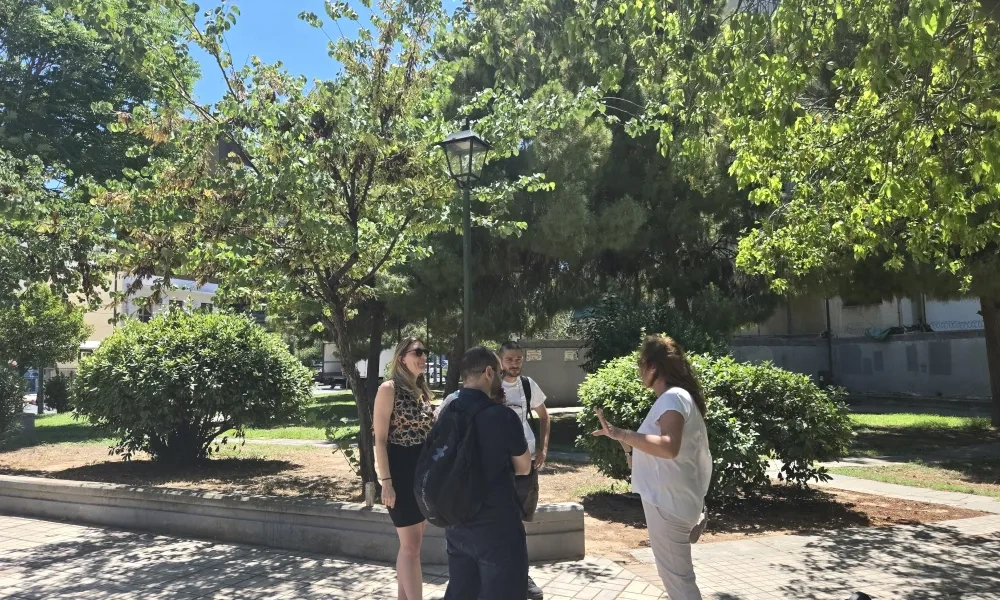
During the first six months, administrative and management procedures were established, and strong collaborative momentum developed among partners. Several site visits were conducted, including one with the participation of the Innovation Expert.
An extensive list of potential locations was assessed against predefined criteria, leading to the final selection of seven areas: Ilissia, Metaxourgeio, Kolonos, Exarchia, Promponas, Ampelokipoi, and Kypseli.
Assessment of Intervention Areas
The evaluation considered factors such as land ownership, availability of water infrastructure, and proximity to densely built areas to maximize impact. Additional criteria included existing greenery (to avoid plant removal), topography (to leverage natural rainwater flow), and levels of social vulnerability—ensuring that interventions promote environmental equity and equal access. Sites were also assessed for their potential connection to future projects, aiming to enhance the overall urban experience and biodiversity.
Design Studies
Following field visits and on-site assessments, a series of preparatory design studies began, leading to the development of initial intervention concepts. The process drew on analyses of local microclimates, neighborhood culture and history, existing uses, and service networks to identify opportunities for complementarity and upgrading. Partners translated these ideas into illustrated mood boards, now forming the basis for the next project phase.
Looking Ahead
The next phase will focus on transitioning from initial concepts to technically mature implementation studies. Detailed design, engineering, and construction studies will define technical specifications and operational requirements.
Key deliverables will include the preparation of tender documents for national public procurement procedures. In parallel, partners will initiate early market engagement on sustainability, performance requirements, and implementation to ensure readiness and capacity.
Community participation will also begin in September, with one participatory workshop held in each neighborhood. These sessions will engage local communities, ensuring that interventions are both technically robust and socially responsive. They will also serve as platforms to identify needs, address concerns, and foster a sense of collective ownership before the interventions take shape.
Source: Portico