


Designing Microclimates: How Blue and Green Infrastructure Reclaims Public Space in Athens
By Dimitra Theohari and Franziska Paul, ensphere GmbH
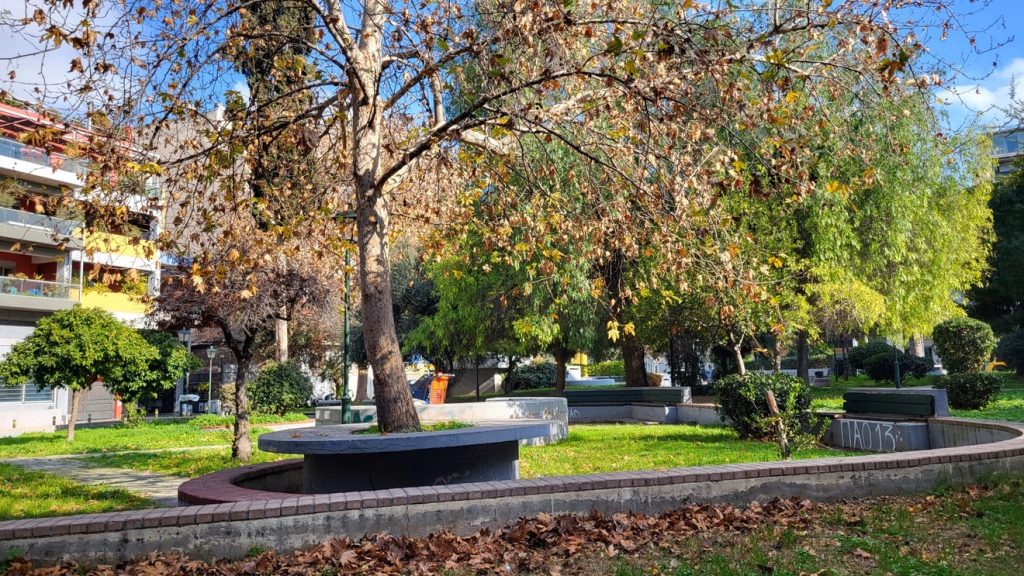
Athens is now facing a new reality in which intense heat and extreme climate events increasingly affect everyday life. In many neighborhoods, public space struggles to provide basic comfort and protection from heat—either because of materials that accumulate heat or due to the lack of shade. The Cooling Havens programme was designed as a meaningful response to these challenges, aiming to create a network of microclimatic refuges across the city. Through interventions at Ramnes Square and Laconia Square, the ensphere team explores how targeted, small-scale, nature-based interventions can truly transform the experience of public space.
When we visited the two areas at the peak of the summer heatwave, the need for immediate action was evident: surface temperatures exceeding 50°C, residents constantly seeking a patch of shade, and older people avoiding the squares altogether during midday hours. These observations, combined with conversations with local residents, clearly highlighted the priorities: more shade, improved air circulation, safety for children, and places where people can stand or sit without overheating. These insights were combined with microclimatic measurements and field analysis, leading to a design approach grounded in nature-based solutions.
Planting and water were not treated as aesthetic additions, but as tools that directly influence the microclimate. Permeable materials, infiltration zones, and carefully designed planting schemes help absorb stormwater and retain soil moisture during dry periods. Trees are positioned to provide shade when it is most needed, forming a passive cooling mechanism that can significantly reduce temperatures. Research on Mediterranean microclimates confirms that even small changes in shading or soil moisture can substantially improve thermal comfort.
The planting design is based on resilient, primarily native species, creating multiple layers of vegetation: groundcover plants that retain moisture, shrubs that enhance biodiversity, and trees that provide year-round shade. This approach reduces irrigation needs while strengthening natural cooling. At the same time, species were selected for their aesthetic qualities—scent, texture, and seasonal interest—ensuring that these spaces remain attractive and vibrant even during the summer months.
The social dimension was equally important. Discussions with residents and shop owners helped define practical elements such as seating placement, quieter corners for rest, and open areas for movement and play. In Southern European cities, squares function as extensions of everyday life. The goal of the new design is to restore this role, offering conditions of comfort that encourage people to stay in the space rather than simply pass through it.

Although the interventions at the two squares are based on the same climatic logic, they were shaped differently according to each site’s local microclimate and neighborhood needs. Ramnes Square, more exposed to heat, required enhanced shading and a stronger focus on water management. Laconia Square, more enclosed, called for a reconfiguration of spaces to improve airflow and to strengthen its role as a neighborhood meeting point. These adaptations highlight that climate resilience cannot rely on a single template; it must emerge from an understanding of each specific place.
One of the most important aspects of Cooling Havens is its role as a model for the entire city. By testing solutions at the neighborhood scale, the project lays the groundwork for policies that systematically integrate Blue and Green Infrastructure into the urban environment. This is not a design trend, but an essential component of urban systems—one that reduces flood risk, enhances biodiversity, and mitigates thermal stress. Equally critical was collaboration with municipal services, ensuring that the designs can be realistically implemented and maintained. Materials, technical details, and planting choices were aligned with the city’s maintenance capacities. Resilience only has value when it can endure.
By transforming two small squares, Cooling Havens demonstrates how ecological design can improve residents’ everyday lives. When climate adaptation is embedded in the spaces we use daily, the benefits become immediately tangible: greater comfort, improved quality of life, and more opportunities for social interaction. In a city facing the impacts of climate change, such interventions point toward a more sustainable future—one in which public space functions simultaneously as a refuge, a shield from heat, and a living ecological system.

Biography
Dimitra Theohari is an architect, engineer, and landscape designer with 15 years of international experience in ecological urban design and the creation of resilient public spaces. As Managing Director of ensphere GmbH, she leads projects that integrate Blue and Green Infrastructure, nature-based solutions, and urban transformation. Her work spans Europe and Central Asia, including award-winning designs for the Institut der Feuerwehr in Münster and Telgte, the outdoor spaces of Leuphana University, and major cultural interventions in Tashkent.
She specializes in integrating systems thinking into urban landscapes, with a focus on heat reduction, biodiversity enhancement, and sustainable water management. She has contributed to strategic frameworks, research initiatives, and public partnerships—most recently through the microclimatic redesign of public spaces for the Cooling Havens project. Her practice combines scientific rigor, participatory methods, and a strong commitment to creating cities that are resilient, inclusive, and human-centered.