


Building a European Network of Climate-Resilient Cities
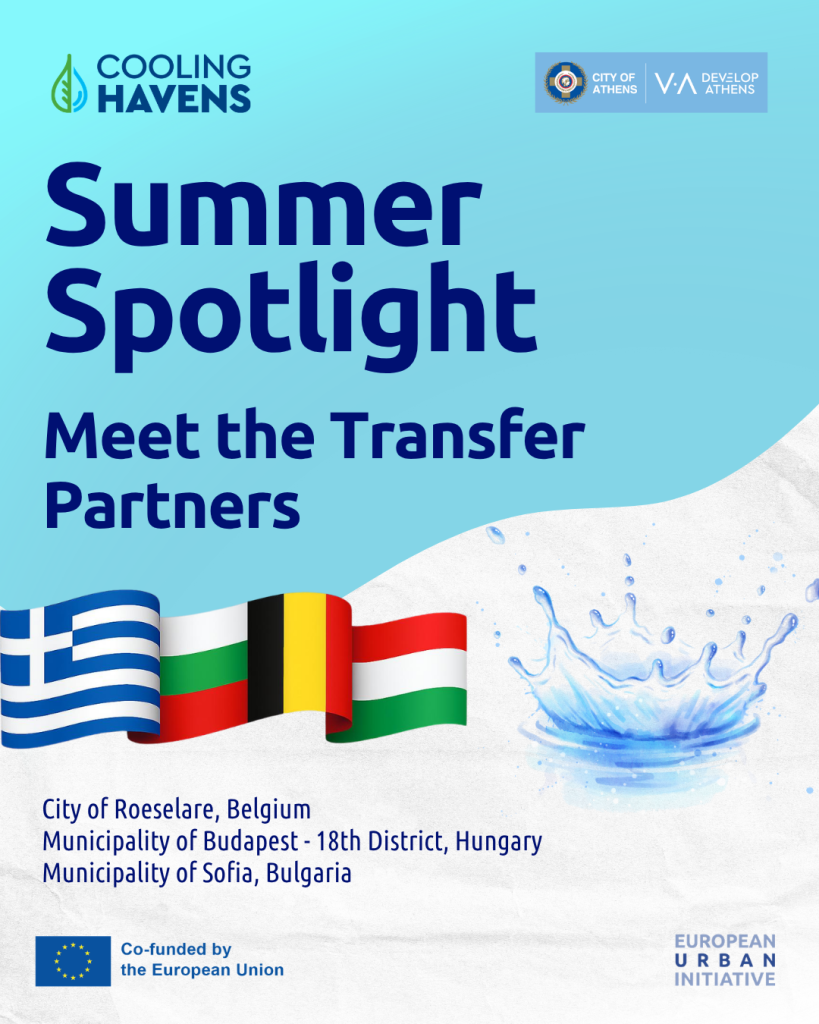
Within the framework of the European Urban Initiative (EUI) project Cooling Havens, the Work Plan for Transfer Partners (WP8) represents one of the project’s most strategic and forward-looking components. While the core interventions of the project are implemented in Athens, this work plan expands the project’s impact across Europe through structured cooperation with the Transfer Partners: the City of Roeselare (Belgium), Budapest’s 18th District (Hungary), and the Municipality of Sofia (Bulgaria).
The Transfer Partner Cities
Roeselare (Belgium)
Roeselare is increasingly confronted with the effects of climate change, including rising temperatures, intense rainfall events, and longer dry periods that place pressure on the urban environment. Challenges such as urban flooding, reduced water absorption, and heat accumulation are closely linked to the extensive presence of impermeable surfaces across the city.
In response, the city has adopted a forward-looking climate adaptation strategy through the #VANRSL Climate Adaptation Plan, which promotes resilient urban planning, sustainable water management, and climate-conscious public spaces. Through this approach, Roeselare seeks to strengthen environmental resilience while encouraging greater public awareness and more sustainable urban living practices.
Budapest’s 18th District (Hungary)
Budapest’s 18th District is actively pursuing a long-term strategy focused on sustainable urban transformation and climate resilience. The district places particular emphasis on environmentally conscious mobility, the modernization of urban infrastructure, and the regeneration of public and residential spaces to improve quality of life for residents.
At the same time, strengthening institutional coordination and efficient urban governance remains central to its development approach. Facing the increasing impacts of climate change, the district is preparing for significantly hotter summers, prolonged heatwaves, and extended drought periods, conditions that are expected to progressively resemble a Mediterranean climate in the coming decades.
Sofia (Bulgaria)
Sofia is facing increasingly complex urban and environmental challenges linked to climate change, particularly rising summer temperatures, recurring flooding events, and the limited integration of green and blue infrastructure within the urban fabric. Densely built neighborhoods with extensive asphalt and concrete surfaces are especially vulnerable to overheating, while outdated drainage systems and low soil permeability intensify flood risks during periods of heavy rainfall.
At the same time, the insufficient connection between green spaces, waterways, and public areas reduces the city’s overall climate resilience and environmental quality. In response, Sofia is exploring more sustainable and nature-based urban planning approaches, including the enhancement of rivers and water elements, the creation of interconnected green-blue public spaces, and stronger citizen engagement in climate adaptation initiatives. Through these efforts, the city aims to improve urban sustainability, public wellbeing, and resilience to future climate pressures.
The Strategic Role of Work Plan 8
Coordinated by the Municipality of Athens and supported through the active contribution of the project consortium partners, as well as the EUI Transfer Expert, WP8 focuses on the transferability of innovative urban cooling solutions and climate-adaptation practices developed through the Cooling Havens project. Its objective is not merely the replication of isolated technical interventions, but the sharing of integrated methodologies that combine blue-green infrastructure, participatory governance, digital monitoring systems, and climate-sensitive urban planning.
The transfer dimension of the project reflects a growing European recognition that cities facing extreme heat and climate stress require collaborative and adaptable solutions. In this context, Athens functions as a living laboratory for urban resilience. Through this work plan, the city shares practical experience in mitigating urban heat island effects through nature-based solutions, water-sensitive design, and public-space regeneration, while simultaneously fostering dialogue with cities facing similar environmental and social challenges.
Mutual Learning and Capacity Building
A central strength of WP8 lies in its emphasis on mutual learning. Transfer Partners are not passive observers; rather, they actively engage in workshops, thematic exchanges, technical visits, and collaborative planning sessions. These activities allow each city to assess how the Cooling Havens methodology can be adapted to its own urban fabric, governance structure, and climatic conditions.
The process therefore creates a dynamic exchange of knowledge, where local experiences from the partner cities also enrich the overall project.
Particularly significant is the role of institutional capacity building. The work plan strengthens cooperation between municipal departments, urban planners, climate experts, and local stakeholders, helping participating cities develop new skills and governance tools for climate adaptation. The exchange of practical expertise contributes to the creation of a shared European framework for resilient urban development, rooted in both innovation and local applicability.
The Role of the Municipality of Athens
The Municipality of Athens and its partners play a key coordinating role throughout this process. By facilitating transnational collaboration and promoting the dissemination of best practices, Athens reinforces its position as a leading European actor in urban climate governance. At the same time, the city demonstrates how local climate initiatives can generate wider European value through cooperation and knowledge transfer.
Ultimately, this Work Plan transforms Cooling Havens from a local intervention into a broader European platform for urban resilience. Through the active involvement of the Transfer Partners, the project contributes to the development of more sustainable, climate-adaptive, and socially inclusive cities, while strengthening the collective European response to the growing challenges of climate change and extreme urban heat.
Looking Ahead
On behalf of the Municipality of Athens, we are particularly pleased to have strengthened our collaboration with the three Transfer Partner cities through the first official site visits and workshops that took place in Athens in January 2026.
These initial exchanges established a strong foundation of cooperation, mutual learning, and shared commitment toward climate resilience. We look forward to continuing this productive journey through future knowledge-exchange activities, study visits, and collaborative workshops with the Transfer Partner cities within the auspices of the Cooling Havens project.