


What is “Cooling Havens”
Cooling Havens is an innovative European project implemented by the Municipality of Athens, aiming to create cooler, more sustainable, and more resilient neighborhoods in the city by placing water and greenery at the heart of urban regeneration. As Athens faces increasingly intense thermal stress, the project develops green and blue solutions to enhance everyday comfort and improve residents’ quality of life.
Through nature-based interventions in selected areas, Cooling Havens combines smart water management practices, the expansion of urban green spaces, and modern data-monitoring tools to mitigate urban heat islands and strengthen the bioclimatic performance of public spaces.
A core pillar of the project is the active participation of citizens. Through consultations, workshops, and feedback-collection processes, residents co-design the interventions, share their own stories and needs, and contribute to shaping neighborhoods that respond to real, everyday challenges.
Co-funded by the European Union and implemented in collaboration with scientific, municipal, and social stakeholders, the project sets a new benchmark for rethinking our cities—placing people, water, and nature at the center of urban development.
Cooling Havens applies technologies such as water recovery systems for irrigation, rainwater harvesting and reuse, small-scale cooling water infrastructures, and shaded green corridors, introducing a contemporary model of urban resilience.
About the Project
The project is co-funded by the European Urban Initiative (EUI) with €4.99 million from the European Regional Development Fund (ERDF), representing 80% of the total budget. The overall budget amounts to €6.25 million, with an implementation duration of 42 months (December 2024 – May 2028).
The lead urban authority is the Municipality of Athens, working in partnership with 10 stakeholders from public bodies, universities, civil society organizations, and city-based enterprises, as well as with 3 European transfer cities for knowledge exchange.
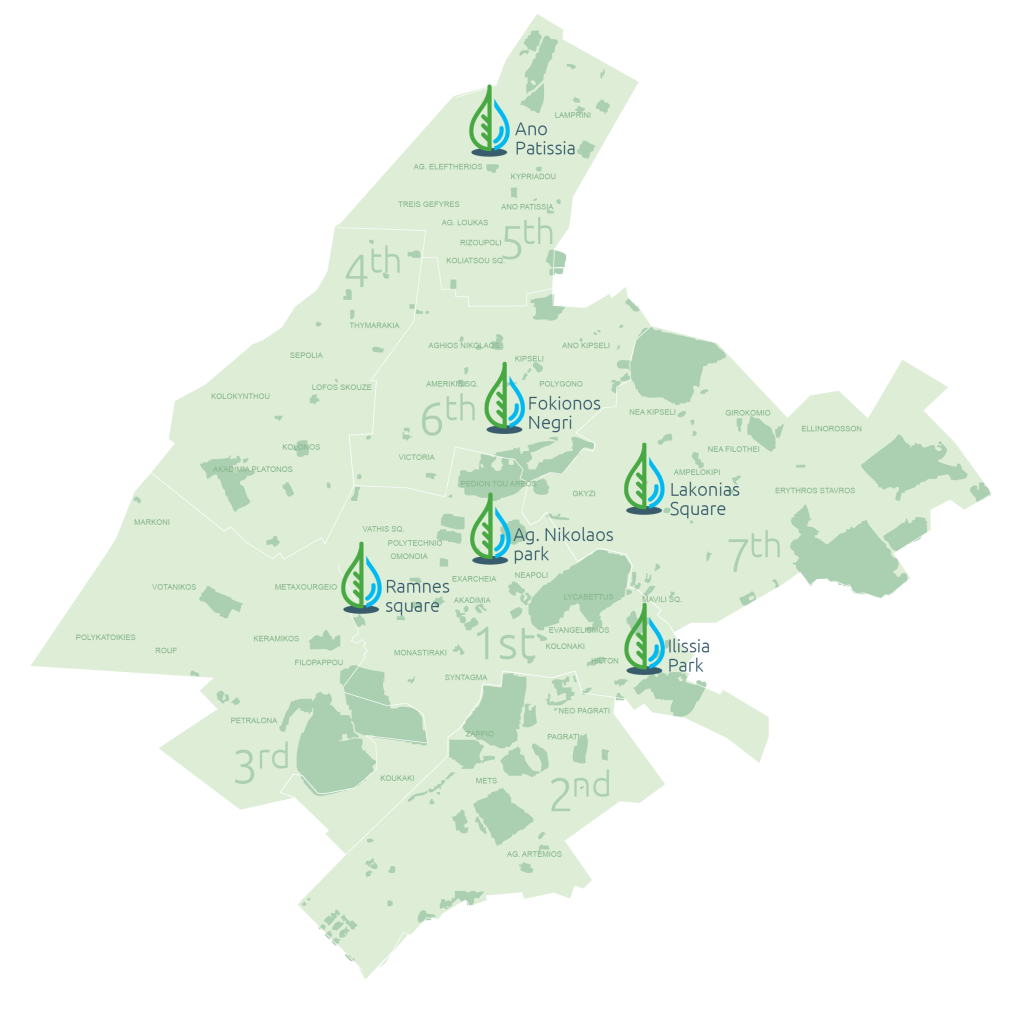
6 Cooling Points will be created in central Athens neighborhoods, offering immediate relief from high temperatures and strengthening the city's long-term resilience.
The interventions will add over 8,000 m² of new water and green-based works and aim for a reduction of approximately 2-5°C in microclimate temperature during heatwave days.
Beyond infrastructures, the project cultivates a new water culture: through schools, educational workshops, artistic installations and the public Open Data Portal, connecting cooling with daily life and public space design.
The project is co-financed by the European Urban Initiative (EUI) with €4.99 million from ERDF (80%) in a total budget of €6.25 million and duration of 42 months (12/2024—05/2028).
The lead urban authority is the Municipality of Athens, with Develop Athens S.A. undertaking financial management and communication actions, within the framework of a consortium of 14 partners from public bodies, universities, civil society organizations and city businesses.



Urban Intervention Sites with a Water-Centric Approach
- Ilissia Park, Ilissia
- Agia Lavra Green Space (ISAP Station), Ano Patissia
- Laconia Square, Ampelokipoi
- Ramnes Square, Kolonos / Metaxourgeio
- Agios Nikolaos Pefkakia Park, Neapoli Exarchia
- Fokionos Negri, Kypseli
Community Education and Participation
- Consultation Hubs & Co-design Workshops
- “Water School” & Digital Storytelling Lab focused on water
- Artistic installations and public cultural actions
- Training programmes for municipal staff, vulnerable groups, and the creation of new employment opportunities
Data Collection and Processing for Policy-Making
- Smart environmental monitoring sensors
- Meteorological stations
- Data Visualization Lab for sustainable water management
- Digital Twin
- Open Data Platform
Main Objectives
Creation of 6 Cooling Havens
Through the project, interventions and solutions that harness the power of nature are designed and implemented. In total, more than 8,000 m² of new water- and green-based projects will be created, aiming to reduce microclimate temperatures by approximately ≥5°C during heatwave days and to retain more than 70% of rainwater during periods of intense rainfall.
Innovation in Management and Smart Sensors
The project integrates smart sensors (IoT) that monitor temperature, humidity, air quality, and water-related data in real time. This data feeds into the project website and supports e-governance through an Open Data Portal accessible to all, enabling evidence-based decision-making.
Athens Water School
The Athens Water School serves as the umbrella for all educational activities of the project, promoting an integrated approach to education on water, climate, and urban resilience. Targeted training seminars are implemented for vulnerable groups, aiming to develop basic skills for the maintenance of the new infrastructures. In parallel, specialized training programmes are organized for municipal staff to strengthen their knowledge and skills in water management, microclimate issues, and the operation of water-based interventions. This educational platform also extends to children, enhancing environmental awareness and promoting sustainable water use through creative and experiential activities.
Shaping a New Water Culture
The project fosters a new water culture through schools, educational workshops, and artistic installations, integrating water into the everyday experience of residents.
Participation and Co-Design with the Local Community
Active citizen participation is a core pillar of Cooling Havens. The process goes beyond simple consultation and evolves into a structured pathway of co-creation, from the initial design phase to the operation of the Cooling Havens. At least 120 residents will participate in co-design workshops, contributing decisively to interventions that respond to the real needs of each neighbourhood.
Digital Storytelling Lab
Stories and narratives around water, combined with artistic actions, are incorporated into the project to strengthen shared identity and residents’ sense of ownership. The Digital Lab for Water Memories collects stories, testimonies, and photographic material from Athens neighbourhoods, creating a living digital archive of collective memory for residents and visitors alike.
Knowledge Transfer
The knowledge and expertise generated through the project will serve as a model for other European cities. Through targeted knowledge-transfer activities, the practices of Cooling Havens will be shared with Budapest, Sofia, and Roeselare, supporting the dissemination of innovative solutions for water, microclimate, and urban resilience at the European level.
Creation of New Jobs
The project contributes to the creation of new jobs, strengthening local employment in fields related to green infrastructure, technology, technical support, and environmental education. In this way, Cooling Havens does not simply introduce new water- and green-based infrastructures; it builds networks of trust, strengthens social cohesion, and creates a new culture of responsible water use—one that truly belongs to the citizens.
In this way, Cooling Havens does not simply introduce new water and green-based infrastructures; it builds networks of trust, strengthens social cohesion and creates a new culture of responsible water use that belongs to the citizens.
Innovation
The innovation of Cooling Havens begins at Ilissia Park, where a water recovery system for irrigation is implemented. This system provides clean, reclaimed water for irrigation and creates a new water garden. Combined with rain gardens and bioswales, the solution demonstrates how a city can harness its natural resources in a smart and sustainable way.
The Cooling Havens are not merely technical infrastructures; they function as participatory platforms that integrate innovative design, cutting-edge technology, and cultural creation.
Integrated water technology & low-cost solutions
Two mobile, re-deployable structures demonstrate that affordable solutions can measurably reduce temperatures and be scaled up across other neighbourhoods.
Smart microclimate monitoring
Twenty-five data collection stations and IoT sensors measure temperature, humidity, water consumption, and air quality. All data are published on an Open Data Portal, accessible to both the city and its citizens.
AI-driven optimization
Artificial intelligence algorithms analyse data in real time and regulate water and energy flows, reducing the overall environmental footprint.
Data transformed into art
Interactive multimedia installations convert climate data into visual experiences, engaging the public and enhancing experiential learning around water.
A co-creation ecosystem
From the Athens Water School to the Open Design Competition, the project invites students, artists, technicians, and municipal staff to co-design, maintain, and scale up the interventions—cultivating a new water culture in the city. The result is a first-of-its-kind, innovative solution in Europe that combines the integration of water into public space, digital governance, and social innovation—a model ready to be replicated in other cities facing similar challenges.
Involved Stakeholders
Cooling Havens aims to attract and involve a wide range of entities so that every stage—from design to operation and transfer—is based on collective knowledge and social acceptance.

Artistic Organizations
Enhance public engagement and promote cultural awareness activities.
Local Communities and Interest Groups
Actively participate in consultation processes and help shape interventions with strong social acceptance.
Educational Institutions
Strengthen knowledge and promote education for sustainability.
Institutional Bodies
Ensure coordination and compliance with public policies.
Technical Organizations
Contribute to the design and technical documentation of the project’s infrastructures.
Residents & local communities
Participation in design workshops, use of cooling stations, provision of feedback
Vulnerable groups
Direct access to cooling points, priority in training for green jobs
Municipality of Athens
Policy coordinator, owner and manager of infrastructures
Develop Athens S.A.
Academic Institutions & Research Centers
(NTUA, NKUA, etc.)
Technical studies, IoT sensors, data analysis, impact assessment
NGOs & Social bodies
Artistic community
Green technology businesses & start-ups
Tourism sector & cultural organizations
Political bodies / Transfer Cities (Roeselare, Budapest, Sofia)
Media
Dissemination of results and good practices
Engagement mechanisms: Stakeholder Engagement Observatory (Deliverable D 3.2.2), open workshops